
Introduction: The Evolving Landscape of Cardiovascular Pharmacotherapy
Cardiovascular disease remains the leading cause of morbidity and mortality worldwide, with heart failure alone affecting approximately 64 million people globally . For researchers conducting preclinical and clinical investigations, access to high-quality cardiovascular compounds is essential for advancing scientific understanding and therapeutic development.
This comprehensive guide provides an in-depth pharmacological and preclinical overview of three breakthrough cardiovascular agents: Entresto (Sacubitril/Valsartan) , Samsca (Tolvaptan) , and Verquvo (Vericiguat) . These molecules represent distinct mechanistic approaches to managing heart failure, hyponatremia, and related cardiovascular conditions. Whether you are investigating neurohormonal modulation, aquaresis, or the nitric oxide-soluble guanylate cyclase-cyclic guanosine monophosphate (NO-sGC-cGMP) pathway, this resource will equip you with essential facts, safety profiles, and sourcing guidance.
At Peptides Wellness Lab, we understand that reproducibility in cardiovascular research depends on compound integrity. This guide will help you make informed procurement decisions for your next groundbreaking study.
Section 1: The Science of Cardiovascular Research – Understanding the Targets
Before diving into individual compounds, it is essential to understand the pathophysiological pathways these agents target.
1.1 The Neurohormonal Model of Heart Failure
Heart failure with reduced ejection fraction (HFrEF) is characterized by the activation of multiple neurohormonal systems, including the renin-angiotensin-aldosterone system (RAAS) and the sympathetic nervous system. While initially compensatory, chronic activation leads to myocardial remodeling, fibrosis, and disease progression.
1.2 The NO-sGC-cGMP Pathway
The nitric oxide-soluble guanylate cyclase-cyclic guanosine monophosphate (NO-sGC-cGMP) pathway plays a critical role in cardiovascular homeostasis . In patients with heart failure, this pathway is dysregulated due to:
- Decreased nitric oxide (NO) availability
- sGC desensitization to NO
- sGC deficiency
- Reduced cGMP signaling
These deficiencies contribute to myocardial and vascular dysfunction, accelerating heart failure progression . Vericiguat directly addresses this pathway through sGC stimulation.
1.3 Vasopressin and Water Balance
Arginine vasopressin (AVP) is a hormone that regulates water balance through V2 receptors in the renal collecting ducts. In hypervolemic and euvolemic hyponatremia—conditions often associated with heart failure, cirrhosis, and syndrome of inappropriate antidiuretic hormone (SIADH)—excessive AVP activity leads to water retention and dilutional hyponatremia . Tolvaptan (Samsca) provides targeted V2 receptor antagonism to address this pathophysiology.
Section 2: Comprehensive Compound Profiles
2.1 Entresto (Sacubitril/Valsartan): The First-in-Class ARNI
Drug Class: Angiotensin Receptor-Neprilysin Inhibitor (ARNI)
FDA Approval Date: July 7, 2015
Applicant Holder: Novartis Pharmaceuticals Corp
Dosage Form: Oral tablet
Strengths: 50 mg, 100 mg, 200 mg (Sacubitril/Valsartan combination)
Mechanism of Action:
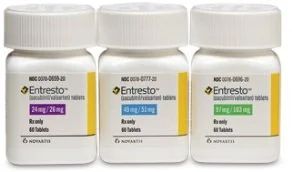
Entresto is a first-in-class combination product containing two active components: sacubitril (a neprilysin inhibitor) and valsartan (an angiotensin II receptor blocker, ARB) . This dual mechanism provides complementary cardiovascular benefits:
- Valsartan component: Blocks the angiotensin II type 1 (AT1) receptor, inhibiting the deleterious effects of RAAS activation, including vasoconstriction, sodium retention, and myocardial fibrosis
- Sacubitril component: Inhibits neprilysin, the enzyme responsible for degrading natriuretic peptides (including BNP and ANP), bradykinin, and adrenomedullin
By inhibiting neprilysin, sacubitril increases the levels of these vasoactive peptides, promoting vasodilation, natriuresis, diuresis, and anti-fibrotic effects—all while valsartan provides complementary RAAS blockade.
Preclinical and Clinical Validation:
The landmark PARADIGM-HF trial demonstrated Entresto’s superiority over enalapril (an ACE inhibitor) in reducing cardiovascular death and heart failure hospitalization. Key findings include:
- 20% relative risk reduction in the primary composite endpoint of cardiovascular death or heart failure hospitalization
- Superior blood pressure lowering compared to RAAS blockade alone
- Favorable safety profile with comparable rates of angioedema to enalapril
Pediatric Indications:
On October 1, 2019, the FDA approved Entresto for the treatment of symptomatic heart failure with systemic left ventricular systolic dysfunction in pediatric patients aged one year and older . This approval was supported by a randomized, double-blind clinical study demonstrating NT-proBNP reduction from baseline to 12 weeks, which included:
- 90 patients aged 6 to 18 years
- 20 patients aged 1 to 6 years
Safety and effectiveness have not been established in pediatric patients less than 1 year of age .
Pharmacokinetics:
Sacubitril is rapidly metabolized to its active metabolite (sacubitrilat) by esterases. Valsartan has well-characterized pharmacokinetics with an oral bioavailability of approximately 25%. Both components are eliminated via multiple pathways, reducing drug interaction potential.
Drug Interactions:
- ACE inhibitors: Concurrent use increases the risk of angioedema; a 36-hour washout period is required when switching between therapies
- Potassium-sparing diuretics and potassium supplements: May increase serum potassium levels
- NSAIDs: May reduce antihypertensive effects and increase renal risk
- Lithium: Serum lithium levels may increase
Safety Considerations:
- Hypotension: Symptomatic hypotension may occur, particularly in volume-depleted patients
- Hyperkalemia: Monitor serum potassium, especially in patients with renal impairment or diabetes
- Renal impairment: Reversible reductions in renal function may occur
- Angioedema: Rare but serious; discontinue immediately if suspected
- Fetal toxicity: Avoid use during pregnancy
Researcher’s Note: Entresto represents a paradigm shift in HFrEF management, offering superior outcomes compared to ACE inhibitors. Its pediatric approval expands research applications into younger populations.
Source Entresto for your cardiovascular research: Buy Entresto
2.2 Samsca (Tolvaptan): The Selective Vasopressin V2 Receptor Antagonist
Drug Class: Selective vasopressin V2 receptor antagonist (vaptan class)
FDA Approval Date: May 2009
Therapeutic Indications:
- Clinically significant hypervolemic and euvolemic hyponatremia (serum sodium <125 mEq/L) associated with heart failure, cirrhosis, or SIADH
- Slowing kidney function decline in adults at risk of rapidly progressing autosomal dominant polycystic kidney disease (ADPKD)
Mechanism of Action:
Tolvaptan is an orally administered, nonpeptide, selective arginine vasopressin V2 receptor antagonist . By blocking V2 receptors in the renal collecting duct, tolvaptan:
- Increases free water clearance (aquaresis)
- Corrects low serum sodium levels without affecting electrolyte excretion
- Produces net water loss without activating neurohormonal systems
This mechanism distinguishes tolvaptan from conventional diuretics (e.g., furosemide, thiazides), which promote both water and electrolyte excretion and may worsen hyponatremia.
Clinical Efficacy:
The SALT (Study of Ascending Levels of Tolvaptan in Hyponatremia) trials demonstrated tolvaptan’s efficacy :
- Significant and sustained increases in serum sodium levels
- Improvement in mental status and physical function
- Well-tolerated with predictable dose-response relationship
ADPKD Indication:
Tolvaptan is the first disease-modifying agent for patients with ADPKD at risk of rapid progression . Clinical trials demonstrated:
- Slowed expansion of total kidney volume
- Reduced decline in kidney function
- Delayed time to end-stage renal disease
Pharmacokinetics:
Tolvaptan is metabolized primarily by CYP3A4. Drug interactions with strong CYP3A4 inhibitors (e.g., ketoconazole, clarithromycin) or inducers (e.g., rifampin, phenytoin) are clinically significant .
Safety Profile:
- Common adverse reactions: Thirst, dry mouth, polyuria, increased urination frequency (predictable due to mechanism)
- Serious adverse events: Excessive correction of hyponatremia (risk of osmotic demyelination syndrome), liver injury (requires monitoring)
- Contraindications: Hypovolemic hyponatremia, anuria, inability to sense or respond to thirst
Researcher’s Note: Samsca is uniquely valuable for research involving water balance disorders, heart failure management, and polycystic kidney disease. Its aquaresis mechanism (water-selective diuresis) distinguishes it from traditional loop diuretics.
Acquire Samsca for hyponatremia and renal research: Buy Samsca
2.3 Verquvo (Vericiguat): The First-in-Class sGC Stimulator
Drug Class: Soluble Guanylate Cyclase (sGC) Stimulator
FDA Approval Date: January 20, 2021
Development Status: Approved for chronic HFrEF in adults
Administration: Oral, once daily
Mechanism of Action:
Vericiguat is a novel, first-in-class oral sGC stimulator that targets the NO-sGC-cGMP pathway . The mechanism involves two complementary actions:
- Direct sGC stimulation: Activates sGC independent of NO availability
- NO-sGC binding stabilization: Enhances the effects of endogenous NO by stabilizing the NO-sGC binding
By restoring cGMP activity, vericiguat produces :
- Vasodilation of coronary, pulmonary, and peripheral vasculature
- Reduced myocardial stiffness and fibrosis
- Improved ventricular-vascular coupling
- Potential anti-inflammatory and anti-remodeling effects
The VICTORIA Trial – Pivotal Clinical Evidence:
The phase III VICTORIA trial enrolled 5,050 patients with chronic HFrEF (NYHA class II-IV), left ventricular ejection fraction <45%, elevated natriuretic peptide levels, and a recent heart failure decompensation event (hospitalization or outpatient intravenous diuretics) .
| Endpoint | Vericiguat vs. Placebo | Statistical Significance |
|---|---|---|
| Primary composite outcome (CV death or first HF hospitalization) | HR 0.90 (10% relative risk reduction) | p=0.02 |
| First HF hospitalization (secondary) | HR 0.90 | p=0.048 |
| CV death alone | Not statistically significant on its own | — |
| Total number of HF hospitalizations | Significantly reduced | p<0.05 |
Target Dose Achievement: 89% of patients treated with vericiguat achieved the target dose .
Subgroup Analysis:
Vericiguat showed no benefit with respect to the primary endpoint in a subgroup of patients with grossly elevated N-terminal pro-brain natriuretic peptide (NT-proBNP) levels .
Pharmacokinetics and Metabolism:
- Primary metabolism: Glucuronidation via UGT1A1 and UGT1A9 isoforms
- Urinary excretion and renal clearance: Low
- No clinically relevant intrinsic factor effects on vericiguat exposure
- Drug interaction potential: Low; no clinically relevant PK/PD interactions with warfarin, digoxin, aspirin, or sacubitril/valsartan
- Most common adverse event: Hypotension (generally well-tolerated)
- AEs of special interest: Symptomatic hypotension and syncope occurred with low incidences similar to placebo
- No need for laboratory monitoring (unlike some other HF therapies)
- Well-tolerated with good adherence profile
Comparison with Other Contemporary HF Trials:
The VICTORIA trial had a less powerful effect than DAPA-HF (dapagliflozin) and EMPEROR-Reduced (empagliflozin) on HF outcomes, but this reflects a setting of more severe disease, higher event rates, and shorter follow-up . Vericiguat remains an important option for high-risk patients who have experienced a recent worsening event despite guideline-directed medical therapy .
Research Applications:
- Comparative studies of novel HF therapies
- Combination therapy investigations with existing GDMT
- NO-sGC-cGMP pathway research
- High-risk HFrEF patient populations
Researcher’s Note: Vericiguat represents the fifth pillar of HFrEF pharmacotherapy (alongside beta-blockers, RAAS inhibitors, MRAs, and SGLT2 inhibitors). Its unique mechanism targeting the NO-sGC-cGMP pathway fills an important therapeutic gap.
Source Verquvo for advanced heart failure research: Buy Verquvo
Section 3: Comparative Pharmacology – Choosing the Right Agent for Your Research
3.1 Mechanism-Based Selection Guide
| Research Focus | Recommended Agent | Rationale |
|---|---|---|
| Heart failure with reduced ejection fraction (HFrEF) | Entresto or Verquvo | Entresto provides ARNI mechanism; Verquvo offers NO-sGC-cGMP targeting |
| Pediatric heart failure (≥1 year) | Entresto | Only agent with pediatric approval |
| Hyponatremia (SIADH, cirrhosis, HF) | Samsca | Selective V2 antagonism for aquaresis |
| Autosomal dominant PKD progression | Samsca | First disease-modifying agent for ADPKD |
| Worsening HF despite standard therapy | Verquvo | Specifically studied in post-worsening event patients |
| Comparative ARNI vs. ACE inhibitor studies | Entresto | Gold standard for ARNI research |
| Water balance/vasopressin physiology | Samsca | Selective V2 blockade without electrolyte loss |
| NO-cGMP pathway research | Verquvo | First-in-class sGC stimulator |
3.2 Efficacy Comparison in Heart Failure
| Agent | Mechanism | Primary Endpoint Reduction | Target Population |
|---|---|---|---|
| Entresto (Sacubitril/Valsartan) | ARNI | 20% RRR (CV death/HHF) | HFrEF, ambulatory |
| Verquvo (Vericiguat) | sGC stimulator | 10% RRR (CV death/HHF) | HFrEF, recent worsening event |
| Samsca (Tolvaptan) | V2 antagonist | Not applicable (hyponatremia) | Hypervolemic/euvolemic hyponatremia |
3.3 Drug-Drug Interaction Profiles
Section 4: Safety and Toxicology Considerations for Researchers
4.1 Entresto Safety Profile
| Adverse Effect | Incidence | Clinical Significance |
|---|---|---|
| Hypotension | Common | Monitor volume status; adjust diuretics |
| Hyperkalemia | Common | Monitor serum potassium |
| Renal impairment | Common (reversible) | Monitor serum creatinine |
| Angioedema | Rare (<0.5%) | Discontinue if suspected |
| Cough | Less than ACE inhibitors | Improved tolerability |
Contraindications:
- Concomitant ACE inhibitor use (36-hour washout required)
- History of angioedema with previous ACE or ARB therapy
- Pregnancy (fetal toxicity)
4.2 Samsca Safety Profile
| Adverse Effect | Incidence | Clinical Significance |
|---|---|---|
| Thirst, dry mouth | Very common | Predictable due to mechanism |
| Polyuria, increased urination | Very common | Dose-related |
| Excessive sodium correction | Rare | Risk of osmotic demyelination syndrome |
| Liver injury | Rare (requires monitoring) | Monitor liver enzymes |
Boxed Warning:
- Initiate and re-initiate only in a hospital setting with serum sodium monitoring
- Excessive correction of hyponatremia (>12 mEq/L/24 hours) is associated with osmotic demyelination syndrome
4.3 Verquvo Safety Profile
| Adverse Effect | Incidence | Clinical Significance |
|---|---|---|
| Hypotension | Most common | Generally well-tolerated |
| Symptomatic hypotension | Low, similar to placebo | No unique safety signals |
| Syncope | Low, similar to placebo | No dose adjustment required |
| Laboratory abnormalities | None significant | No routine monitoring needed |
- No need for laboratory testing
- Low drug interaction potential
- High target dose achievement (89%)
Section 5: Sourcing Considerations for Cardiovascular Research Compounds
5.1 Quality Attributes for Research Compounds
When procuring Entresto, Samsca, or Verquvo for research purposes, verify the following:
| Attribute | Specification | Verification Method |
|---|---|---|
| Identity | Correct API (sacubitril/valsartan, tolvaptan, vericiguat) | HPLC, mass spectrometry |
| Purity | ≥98% (pharmaceutical grade) | HPLC chromatogram |
| Dosage strength accuracy | Within labeled specification | Assay testing |
| Impurity profile | Meets pharmacopeial limits | HPLC, GC |
| Dissolution profile | Appropriate for oral administration | USP dissolution apparatus |
5.2 Stability and Storage Requirements
| Agent | Storage Requirement | Notes |
|---|---|---|
| Entresto (tablets) | Room temperature (20-25°C) | Protect from moisture |
| Samsca (tablets) | Room temperature | Standard pharmaceutical storage |
| Verquvo (tablets) | Room temperature | Stable under normal conditions |
5.3 Regulatory Status for Research
All three agents are approved for human use in multiple jurisdictions:
- Entresto: Approved by FDA (2015), EMA, and multiple other regulatory bodies
- Samsca: Approved by FDA (2009), with additional approval for ADPKD
- Verquvo: Approved by FDA (2021) for HFrEF
For research use, ensure compliance with local regulations regarding the procurement and handling of prescription pharmaceutical compounds.
Section 6: Emerging Research Frontiers
6.1 Entresto Research Beyond HFrEF
Current research is exploring Entresto in:
- Heart failure with preserved ejection fraction (HFpEF)
- Post-myocardial infarction remodeling
- Hypertension (particularly resistant hypertension)
- Chronic kidney disease with albuminuria
6.2 Samsca Research Applications
Beyond approved indications, Samsca is being investigated for:
- Acute heart failure with congestion and hyponatremia
- Polycystic kidney disease (pediatric populations)
- Syndrome of inappropriate antidiuretic hormone (SIADH) of various etiologies
- Cirrhosis-associated hyponatremia
6.3 Verquvo Research Directions
Emerging research areas for vericiguat include:
- HFpEF (SOCRATES-Preserved and VITALITY-Preserved trials)
- Combination therapy with other GDMT agents
- Long-term mortality benefits (ongoing)
- Specific patient subpopulations (e.g., those with renal dysfunction)
Section 7: Complete Product Sourcing List
For all your cardiovascular research compound needs, Peptides Wellness Lab provides high-quality, rigorously tested research compounds.
Direct Product Links:
Conclusion: Advancing Cardiovascular Research Through Quality Sourcing
The cardiovascular pharmacotherapeutic landscape has been transformed by three distinct mechanistic approaches represented by Entresto, Samsca, and Verquvo.
Entresto (Sacubitril/Valsartan) revolutionized HFrEF management as the first ARNI, demonstrating superiority over ACE inhibitors and providing a new standard of care. Its pediatric approval expands research opportunities into younger populations .
Samsca (Tolvaptan) offers a targeted approach to hyponatremia through selective V2 receptor antagonism, while also providing the first disease-modifying therapy for ADPKD .
Verquvo (Vericiguat) represents the first approved sGC stimulator for HFrEF, targeting the NO-sGC-cGMP pathway and providing an important option for high-risk patients who have experienced a recent worsening event .
For researchers, understanding the distinct mechanisms, safety profiles, and research applications of these agents is essential for designing rigorous studies and interpreting preclinical and clinical data. The VICTORIA trial’s success with vericiguat—demonstrating a 10% relative risk reduction in the primary composite outcome —highlights the continued importance of novel pathway targeting in cardiovascular drug development.
As you design your next cardiovascular study, remember that compound quality directly impacts data integrity. Peptides Wellness Lab is committed to providing the high-quality research compounds you need to advance scientific discovery in cardiovascular medicine.